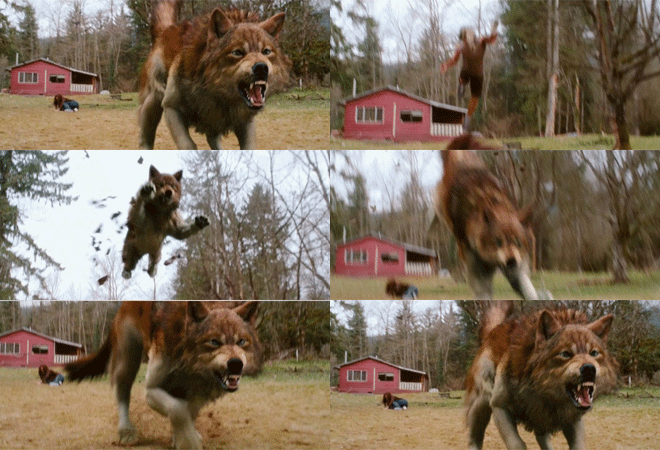
Aroooooo! Get your licks on and scruff some fur, it's Wolves Month at ALASL. Know a great wolves fic that you would like to see recommended? Email us at alteredandsacrificial@gmail.com or tweet us @ALASL if you have a suggestion!
Lamb Affiliates
WANT TO AFFILIATE?
Interested in becoming affiliated with our little blog? We're interested in becoming affiliated with you! Here's the deal: grab one of our affiliate buttons provided here to add to your affiliate list, and send us your 100x100 affiliate buttons to:
alteredandsacrificial@gmail.com
So I noticed a word the other day while reading a fan fic, and I realized that I've seen this problem before. Again, it's another homophone confusion (isn't it always?).
FAZE VERSUS PHASE
FAZE --> a verb, and it means to cause embarrassment or social distress. More often than not, it is used to indicate that one has NOT been embarrassed or socially distressed, as in "Carlisle is never fazed by the smell of human blood."
PHASE --> can be a noun ~ a regular part of a cycle or progression (a phase of the moon or a phase of one's life), or it can be a verb ~ to make gradual changes. Of course, we Twihards know it best when we refer to the wolves' changing back and forth between their human and wolf forms.
Allow me to illustrate the difference:
Paula and Randy are FAZED by James' performance..James is not FAZED by their reaction:
After August 24th's GG segment on pluralized surnames, one of our followers, whisper19, requested that I discuss the proper usage of Volturi in writing. Seeing as how I'm of Italian origin, and seeing as how the Volturi are an integral part of many a Twi-fic, allow me to give you a brief - and EASY - breakdown of plural formation in Italian.
In English, we don't distinguish between masculine and feminine forms, but all nouns actually have this distinction. And you will find that once you know which gender a noun is in one language, it will remain that way in all languages of the same language family (for example, the six most widely spoken Romantic languages - languages that descend from Latin - include Italian, French, Portuguese, Spanish, Romanian, and Catalan).
General Italian nouns that end in -o- are masculine, while Italian nouns that end in -a- are feminine.
PLURAL FORMS OF ITALIAN MASCULINE NOUNS ENDING IN -O (SINGULAR, PLURAL, ENGLISH)
Now, technically the singular form of Volturi would be Volturo - but I highly doubt one would write, "The Volturo approached languidly from his throne." Ahem.
But you would never do the following in Twi-fic:
"The Volturis are coming." Sweet baby Jesus, Volturi is already plural! Do not - I repeat - do not add an -s- at the end!
VOLTURI is a noun unto itself, and as such should never be altered.
Um...wow. I've been so caught up in my own little world that I just realized as I sat down to write this that I missed the last two weeks' GG segments. Huh.
Well, thanks to Bacon Butt, who sent me the link, I have a nice little copy/paste action I'll stick in here about a word I can't stand - IRREGARDLESS.
My mother uses it constantly, even though I tell her she's negating the actual meaning of REGARDLESS by using it. She doesn't care. She thinks she sounds more edumacated, methinks, when she uses it.
She's wrong. End of.
So, don't make the same mistake, Lambchops. Read this bit by cracked.com, and learn:
Irregardless
People think it means:
Regardless.
Actually means:
Not a damned thing.
This is not a word. Now, we have no problem with making up words (if a particular scent can only be described as "fartalicious," we reserve the right to call it so). The problem with this one is "regardless" already means something isn't worth regard (that's why the "less" is there) so adding the "ir" to it means... it's worth regarding again? Who knows.
Should you care?
If there's ever a time to speak up, this is probably it. Mainly because this is one of those words used almost exclusively by people trying to sound smarter than they are. Remind them that when using fake words to at least try to use ones that have some kind of meaning, if they want to avoid unnecessary cockulance when speaking.
Dick Rating:
As in, "How big of a dick are you if you insist people use it the right way?"
I would like to thank JamesRamsey, author of Insecurities, for feeding me with today's segment!
QUIT versus QUITE versus QUIET
Mmmm hmmm...
Three different words, but they seem to be used interchangeably QUITE often, yes? My mind becomes QUIETLY peaceful when I see that an author has QUIT using the three incorrectly.
Let's dissect, shall we?
QUIT: put an end to a state or an activity; I almost went back. I almost turned around and fell down on my knees and started begging again. But I knew that I had to quit Bella, quit her cold turkey, before she killed me, like she was going to kill him. Jacob, Breaking Dawn
QUITE: adverb; completely; entirely; really; truly; positively; to some, or a considerable, degree or extent; very or fairly; "If I'm away from you for any length of time, I'll have to start over again. Not quite from scratch, though, I think." Edward Cullen, Twilight
QUIET: making little or no noise; I heard my favorite sound in the world: Edward’s quiet laugh, weak with relief. Bella Swan, Twilight
Merina: yep. Perfectly good fic, everything else is FINE, until the "beckon call" pops up.
me: LOL...I don't think I have ever seen that one...
Merina: I mean, I can understand because beckon is a word, and beckon means...beckon. And beck and call means someone can beckon you whenever they want...and now that I've said it so many times, it's starting to sound dirty.
Want to know something funny? Beck actually originates from beckon (duh), so technically one isn't too far off when they use the incorrect form of beckon call.
So, let's look at the meaning and origin of the term beck and call per The Phrase Finder and have a little chuckle:
Beck and call
Meaning
To be at someone's beck and call is to be entirely subservient to them; to be responsive to their slightest request.
Origin
'Call' is used here with its usual meaning. 'Beck' is more interesting. The word, although current in English since the 14th century, isn't one that is found outside the phrase 'beck and call' these days. It is merely a shortened form of 'beckon', which we do still know well and understand to mean 'to signal silently, by a nod or motion of the hand or finger, indicating a request or command'.
If the term 'beck and call' had originated prior to the 14th century we would presumably now say 'beckon and call'. It didn't though and the first recorded use of 'beck and call' in print is in McLaren's Sermons, 1875:
"Christ's love is not at the beck and call of our fluctuating affections."
That is straightforward enough. What brings the phrase to the attention of etymologists is the confusion that some people have between it and 'beckon call'. This supposed phrase is a simple mishearing of 'beck and call'. The mistake comes about because no one uses 'beck' any longer, whereas 'beckon' is commonplace.
'Beckon call' could be said not to be a phrase in English at all, but it is gaining some ground nevertheless. At present (January 2007) Google finds 28,000 hits for 'beckon call' and 474,000 for 'beck and call'.
The misspelling began in the USA in the early 20th century. For example, this early citation from The Modesto News-Herald, May 1929:
A crowd of several hundred people heard a stirring address by B. W. Gearhart, Fresno attorney and American Legion official. "Down through the history of American wars, from the Revolutionary to the recent World conflict." the speaker declared, "America always has had at its beckon call men who would give their all for their country that people might enjoy peace and freedom.
The rogue phrase still appears in print in newspapers. Here's a recent example from the London Daily Mirror, by Phil Differ and Jonathan Watson:
"He [football manager Dick Advocaat] told me what he was particularly looking forward to when he comes to Scotland and that's having the entire Scottish press at his beckon call and I promised he won't be disappointed."
Just because 'beckon call' is based on a mishearing that doesn't mean it won't one day become accepted as proper English. Other phrases, like 'beg the question' for instance are routinely used incorrectly by so many people that the incorrect usage has now become the standard. Let's hope 'beckon call' dies a natural death, not only because it is essentially just a spelling mistake but because its adoption would signal the last gasp of the enjoyable little word 'beck'.
Wendy has noticed that there is confusion between dear and deer in some of the stories she's read. I have to assume it's something Carlisle, Esme, or even Edward has said when using the term of endearment dear. Deer is not a term of endearment...unless you have a strange sense of humour.
Esme: "Bella, dear, would you like me to make you dinner?"
Wendy says, "Can't tell you how many times Jasper was out in the dessert in Texas and how Bella wanted to eat him for desert."
Mmm hmm...
Well, let's see now - dessert is something luscious and sweet and packs too many calories. You eat it! A desert is a dry, isolated, unforgiving, barren wasteland.
Came across one today----- (okay, I'm snickering here)
come versus cum
Work with that, bb (yeah, I'll work with that one, Wendy!)
To cum or to come? That is the question!
To be perfectly frank, both terms are correct. Many publishing houses have put forth books where cum is the slang term used to reference semen, ejaculation, or orgasm.
I used to come from the mindset that orgasming should be separated from the act of 'moving towards something', as in the difference between the following two sentences:
"Are you cumming for me, baby?"
"Mom, I'm coming for dinner!"
I used to think one would want a distinction between the two words.
But in reality, when one orgasms, one is actually 'moving towards something' (ie. release). So, I have changed my tune.
Plus, by definition, cum is a Latin word with several meanings, including with, when, since, and although (used in Latin honors) - it has nothing to do with sex.
Also, being a stickler for consistency, I have to object to the word cum and any of its derivatives because how does one say cum in the past tense - cummed? No, one would say came...which comes from come...err...you get the idea?
EVERYONE WHO KNOWS THE DIFFERENCE COMPLAINS ABOUT THIS!!!
Definitely is the word authors are looking to use most of the time.
Per Merriam-Webster:
Main Entry: def·i·nite
Pronunciation: \ˈde-fə-nit, ˈdef-nət\
Function: adjective
Etymology: Latin definitus, past participle of definire
Date: 1553
1 : having distinct or certain limits
2 a : free of all ambiguity, uncertainty, or obscurity b : unquestionable, decided
3 : typically designating an identified or immediately identifiable person or thing the>
Definatly is just an incorrect spelling of definitely, but it's seen often enough that it warrants a place in this post.
Defiantly is seen SO often in fan fiction in place of definitely that it should be burned unless it's being used with its intended meaning.
Per Merriam-Webster:
Main Entry: de·fi·ant
Pronunciation: \-ənt\
Function: adjective
Etymology: Middle French, from Old French, present participle of defier to defy
Date: 1583
: full of or showing defiance : bold, impudent
— de·fi·ant·ly adverb
So, I'm sipping some tea, enjoying some beautiful grammar girl fuckery provided by Lucy (she's a Lamb right down to her little black heart, that one is) and I'm perusing my gmail because it's jam packed with Grammar Girl ideas. Which one to choose...hmm...
I'll go with Wendy's request of surly versus surely. Good one, Lambbaton!
Let's clear this up!
Okay, first of all, THEY DON'T EVEN SOUND THE SAME *clears throat and takes calming breath* Christ, they're not even homophones...yet they pose a problem, don't they my dears?
SURLY is pronounced /sir + lee/ and according to Merriam-Webster:
Main Entry: sure·ly
Pronunciation: \ˈshu̇r-lē, especially Southern ˈshȯr-\
Function: adverb
Date: 14th century
1 : menacing or threatening in appearance
2 obsolete : arrogant, imperious
3 : irritably sullen and churlish in mood or manner
SURELY is pronounced /sure + lee/ and according to Merriam-Webster:
Main Entry: sure·ly
Pronunciation: \ˈshu̇r-lē, especially Southern ˈshȯr-\
Function: adverb
Date: 14th century
1 : in a sure manner: a archaic : without danger or risk of injury or loss : safely b (1) : with assurance : confidently (2) : without doubt : certainly
2 : indeed, really —often used as an intensive
Lucy decided to help Grammar Girl out by contributing what she feels is a horrific homophone problem in fan fiction. She was so adamant about this issue that she scrolled through her tweet history to find her initial tweets about it and retweeted it to moi.
Per Lucy (and Grammar Girl concurs):
It's 'shudder' NOT 'shutter'. Shutters are found on cameras & windows. Shuddering is what I'm doing at your words.
Shutters are like this:
and like this:
Comedy shutters:
Appropriate reason to shudder:
Homer Simpson appropriately displaying the act of 'shuddering':
So, barely and barley get interchanged quite often in fan fiction. I know the switcheroo with the 'l' and the 'e' is a slippery, slippery, slop! Let's ease the issue:
BARELY means scarcely or hardly, as in Bella BARELY survived James' attack in the ballet studio.
BARLEY is a type of grain whose seed is used in malt beverages (like beer), breakfast foods, and it is often used to feed livestock.
Sharon Stone's vag is...BARELY visible here:
Here's a recipe for BARLEY Risotto! Buon appetito!
P.S. FARLY is NOT a word (per my opening 'number').
Last week's Grammar Girl segment on homophones seemed to be a bit of a popular one, with feedback from many of you both here and on Twitter. I'm thinking that the homophone issue is a large problem, and in some cases it can make for some classic comedy.
So, let's all thank Grrlnorth for today's segment. I have never read this in fan fic (at least I don't think so...), but apparently it irks the hell out of my fellow Torontonian. Grrlnorth wrote:
Now can you please explain the difference between waist and waste? It grosses me the fuck out when Jasper puts his arms around Bella's waste. Ewwwwwwww!!!!!!
M'kay...per Merriam-Webster, here is the difference:
waist is "the typically narrowed part of the body between the thorax and hips".
waste is...many things, but Grrlnorth's ewww factor is "excrement —often used in plural".
You don't do this:
You do this, like Jacob *grumble* <-- For real? There are no photoshopped pics of Jasper with his arms around Bella???:
Now for the tricky part. Kitty's paw is on the waist of waste...
Yep. Tina had a beta fail. An absolutely mind-blowing beta fail. I guess the time HAD to come eventually. I mean, none of us are infallible, right? *puffs out chest hoping to still retain 'some' pride* I don't suck THAT badly. Really. I hope...
Meh, I'm Italian AND Catholic. We THRIVE on guilt.
So, in our latest issue of Sunday Selections for March 21, 2010, Maelyn recommended katmom's Guarding Edward. I haven't been able to contribute much this month due to my BETA responsibilities (key word here is BETA). But although I am not contributing to the readings and recommendations this month, I still enjoy reading my co-Lambs' recommendations AND learning a bit more about the authors whose stories are featured here.
Anyway, katmom...I went to her FFn profile page and what do I see? A list of her pet peeves. I usually love it when I see these lists because I like to giggle like a Japanese school girl at what are simple errors (at least to ME).
Well...this is basically what happened when I noticed katmom's differentiation between 'peek', 'peak', and 'PIQUE':
I literally stared at my computer screen in horror, screamed, and then proceeded to have a panic attack, which I took to Twitter...where I called myself a BETATARD, to which fellow super-beta, mrsalreyami, giggled at me...
The SHAME! The HORROR!
Then I scampered off to all the stories I beta to see how much I had royally screwed up.
You know, it's not like my brain doesn't KNOW the difference between 'peek', 'peak', and 'PIQUE' but apparently my brain divorced itself from 'PIQUE' a while ago (I'm assuming). I just recently helped Kay re-edit the first 17 chapters of Colliding Meteors, which has been re-posted to FFn supposedly clean and bee-you-tee-full. HA! HAHA! HAHAHA!
Oh, that's RICH!
Want to know what's even *cough* RICHER? Last week's Grammar Girl, that's what! Why? Because it was all about SPELLING PROPERLY and knowing the difference between homophones!!! HA! HAHA! HAHAHA!
Chapter 1 of Colliding Meteors now has a festering sore called 'peak' staring me in the face. I can't even go into Kay's FFn account to change that ugly mofo warlock bitch because her document manager no longer has Chapter 1 in its reserve. Psst...Kay? Could you do me a favour and upload that puppy again for me so I can fix it? Yeah? Great! My firstborn goes to you, wife *wink* Thank the Lord and all his angels that The Orbiting Meteor and Donna's Running is clean, though. And Lucy's The Last Mile is so twirly, whirly that I don't think anyone would even notice an error as grievous as 'peak' Psst, Lucy...?
And, you know, it wasn't until I read katmom's FFn profile page that I realized that divorce proceedings had actually occurred *grumbles* the woman will probably took all my money and will probably deny me visitation rights...
So, since katmom has proved to be so helpful to me, I shall copy and paste right here her VERY simplistic and excellent explanation of the three homophones:
PEEK -- looking at something
PEAK -- the summit or point of something
PIQUE -- that irritated feeling when you want to sound "all that" about it
Got it? I sure do! I think it's going to follow me to my grave.
Can I offer my explanation for using 'peak' instead of 'pique'? I mean, I like to think it makes SOME sense *scrunches eyebrows together 'cutely' hoping you buy that crock of crap* So, here goes: If one's interest or curiosity is 'piqued', one could say that one's interest or curiosity has 'peaked', as in reached its summit? Yeah? No? Meh...
So, I now enter the world of STUPID. Come one, come all! Point and laugh at me. I am! I'm a beta, for Christ's sake! I'm not SUPPOSED to make this kind of error! I'm supposed to FIND these errors!
*shakes head* Well, I guess I'm a beta who has something to learn...every.single.day.
This 911 call just slays me... Everyone likes to make fun of the husband because he can't spell 'eucalyptus', but come on! The 911 operator is asking him to spell it to him, too. It's 'eucalyptus', guys! You see it once, you never forget it...
I don't think I need to remind everyone that spelling correctly is important. And while I understand that not everyone could compete in the Scripps National Spelling Bee, there ARE sites you can use to confirm if what you're spelling is correct.
Do not rely on spellcheck! Puhleeze...DO NOT RELY ON SPELLCHECK! It will give you the wrong answer most of the time - trust me! Why? Because it's a computer, and it does not understand context. I've seen spellcheck give me 'their' when the obvious word is 'there'. Seriously. I almost hit my computer once.
Actually, I think this is the reason why we see so many 'grammatical' errors - we trust spellcheck far too much.
The better option is to understand basic grammatical rules (for things like the difference between 'their', 'they're', and 'there'...and 'your' and 'you're'...and 'to' and 'too', etc), and then use a site like Merriam-Webster to confirm the spelling of an actual word AND if whether that word is the word you SHOULD use.
Besides...what's the worst that could happen? You learn something new every day, right?
I'm a 36 year old wife and mother of 3. I have always loved to read but my obsession with reading has gotten worse since I found FF. I discovered the awesomeness that is Jasper and haven't looked at another character until Kay invented Peter.
Mae. 38 yr old long time reader and fairly new fanfic author. I'm definitely Team Jasper, but I'll read almost anything with Bella and without Jake as main characters so long as it has a good plot and at least readable grammar and spelling.
I'm probably too old to be doing this. I've got three kids. I'm an addict, but I refuse to seek treatment. My theory is, everybody needs an obsession. This one is at least reasonably healthy. Right? I love reading all the stories "real people" write, and writing my own is part of my justification for continuing with my obsession. This way, I can call it my "creative outlet". Or some such bullshit.
I'm a 33 year old Toronto gal. I like to molest all things 'grammar', thus I'm a Beta. I like to stare, make comparisons, blink rapidly, point and laugh... I am complicatedly simple and simply complicated. Apparently, I'm also considered..."awkward".